Accuracy isn’t a component. It’s a stack — sensing, algorithms, error detection, and software, each doing a specific job.
Four things every MaxMed device shares, whatever it measures.
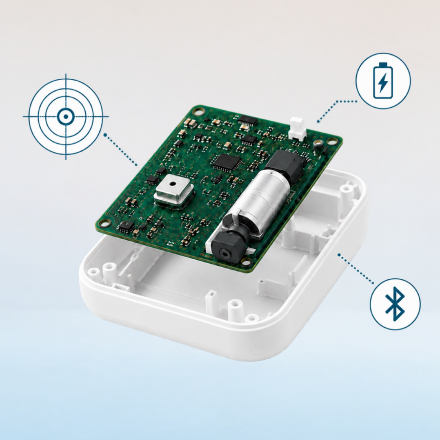
We start with the clinical standard a device has to meet, then design everything else around it.
Movement, poor placement, and irregular signals are detected during the reading — before a wrong number becomes a wrong decision.
Large high-contrast displays, color-coded result states, and voice guidance where it helps.
Bluetooth sync, one app on iOS and Android, native Apple Health integration. Every device joins the same history.
When a cuff inflates and slowly releases, the artery underneath produces tiny pressure oscillations. Our algorithm samples those oscillations hundreds of times per reading, identifies the envelope of the pulse waveform, and rejects artifacts that would distort the result — the same principle used by automated monitors in clinical settings.
An algorithm can be internally consistent and still be wrong. Measurement accuracy is validated against trained clinical observers using a reference standard, across arm sizes, ages, and pressure levels. The protocol is ISO 81060-2. Passing means the device agrees with a clinician.
Most inaccurate home readings are caused by how the measurement was taken. Cuff-fit detection, motion detection, and irregular-heartbeat detection run during the reading and flag the problem before it becomes a wrong number.
Every reading is classified against ACC/AHA categories the moment it completes — as a color-coded screen or a six-level indicator. The number and its meaning arrive together.
Bluetooth Low Energy sync, one app on iOS and Android, native Apple Health integration. Data flows one way: from the device to your history.
Every surface that touches skin is tested to ISO 10993. Cuff bladders are latex-free.
Readings are stored on the device and in your account. We do not sell health data, and you can export or delete your history at any time.

MaxMed is a medical device company built on a simple idea: accuracy shouldn’t be complicated, and clarity shouldn’t be optional.
Explore our devices
